


Andrey_Popov // Shutterstock
How real estate lead generation actually works, and what the data shows about where to focus
Lead generation, along with cold-calling qualified leads, is not the most enjoyable part of any sales job. Real estate, an intensely competitive industry, is no different.
However, there’s no way to eliminate the need for real estate lead generation. If you are new to the industry or don’t have many personal connections in your area, you might be wondering which data you can look at to gather leads.
The good news is that data can tell you a lot about motivated and likely sellers. It’s important, though, to look at the right data. Keep reading this guide from PropertyReach to find out which data you should be focusing on as a real estate investor.
Lead Generation Starts with Finding Motivated Sellers
The most successful investors don’t dial numbers faster than anyone else or even pay for more phone numbers from lead generation services. They understand how to leverage available data to find motivated sellers—or at least identify sellers who have a reasonable possibility of being motivated.
Public records in particular have a lot to do with proper real estate lead generation. The public availability of certain information, such as divorce decrees, varies by jurisdiction, but the following pieces of information should be accessible no matter the state.
- Tax delinquency notices. Homeowners who are behind on property taxes may also be underwater on their mortgage. Either way, a tax delinquency notice is often a strong indicator of a potential seller who needs a cash infusion in the near future.
- Probate records or estate settlements. In some cases, an heir or beneficiary does not wish to take control of property they just inherited. They might favor a quick or cash-only sale for an efficient transaction, especially if they live out of state.
- Absentee or remote ownership (the owner lists a homestead at another address). Absentee owners frequently find that managing a property for renters is more expensive and time-consuming than they originally thought. This situation could be your opportunity to talk to the owner about a quick, low-stress deal.
- Lis pendens notice, which indicates an active court case regarding property ownership. It usually means the lender has initiated foreclosure, but it sometimes means that the court has been asked to settle the question of ownership among multiple claimants. A divorce might also trigger a lis pendens notice.
- Zoning and other code violations. Not having the plumbing or electrical system up to code is another potential indication that a homeowner lacks the financial means to keep up their property. Even minor violations can be helpful for lead generators, as they can show that the current owner is not particularly engaged in the property’s upkeep.
Motivated vs. Likely Sellers
Real estate investors should know the difference between motivated sellers and likely sellers, two distinct terms sometimes used interchangeably.
Likely sellers and their properties have multiple traits that correspond to a potential sale in the near future, but they may not be in a hurry to close. Their mortgage might be close to the maturity date, for instance, or the homeowners might simply be elderly retirees.
Motivated sellers are both likely and motivated because a quick transaction might seem like the best option. Financial stress is one of the most common precursors to motivated sellers, as is a pending divorce.
Successful investors typically have a mix of motivated and likely sellers as a lead pool, but finding truly motivated sellers separates the most successful investors from the rest.
Combining Multiple Data Points is More Likely to Produce Quality Leads
Honing real estate leads involves analyzing multiple pieces of data and scoring each one appropriately. While a lis pendens action is a strong indicator by itself, the property can become an even stronger lead if a tax delinquency notice is also attached to it.
According to ATTOM, in 2024, more than 322,000 lis pendens notices were filed in the U.S. Most investors don’t have time to call (and re-call) every owner of every property in foreclosure. You can maximize your cold-calling windows by prioritizing the hottest properties and working your way down the list.
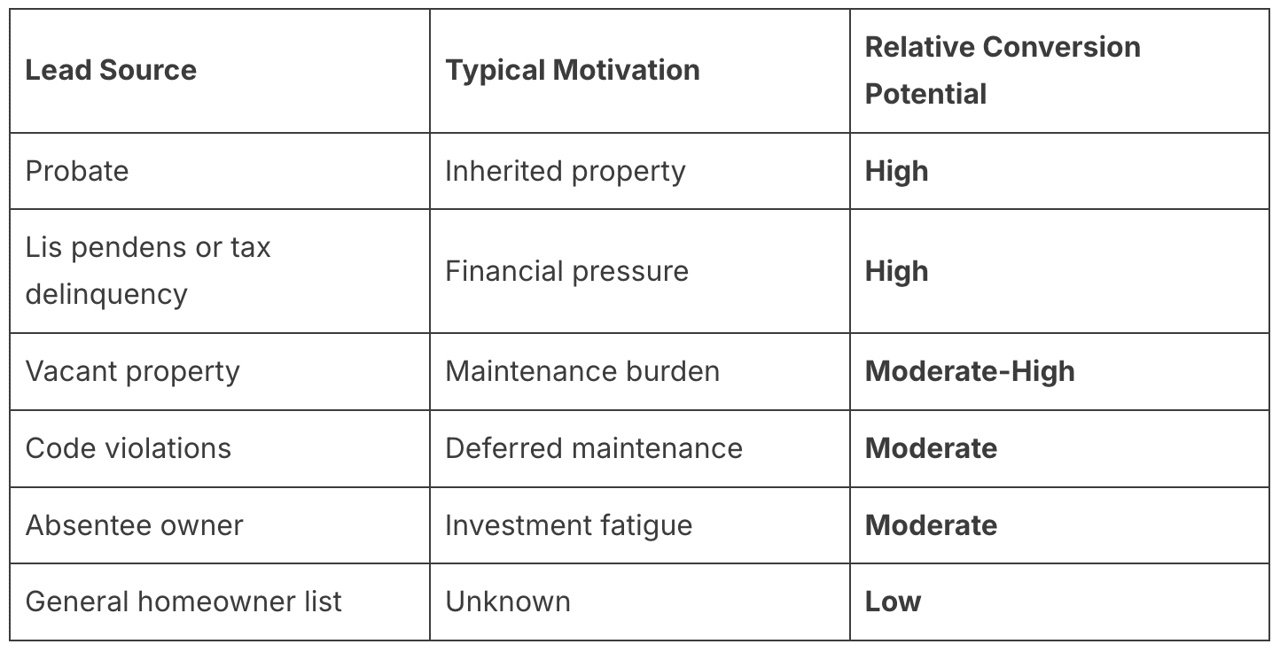
Which types of leads become actual sales most often?
So, how does a successful real estate investor score leads?
While adapting to market conditions and conducting granular research on specific geographic areas (down to individual street levels) is important, the table below offers a good starting point.
PropertyReach
Why the Best Lead Sources Change with the Market
Operating from timely, accurate data is just one piece of the puzzle for real estate professionals looking to generate leads. It’s also important to look beyond raw data and consider the state of mind of sellers and buyers. People’s perceptions about the state of the current real estate market can influence their level of motivation.
Seller’s Market
A seller’s market typically involves fewer homeowners in financial distress. Downstream, investors are locked in extreme competition to find off-market deals.
In these circumstances, you might want to focus more on inherited properties. Emphasize the high amounts of equity in target properties when making your pitch to homeowners.
Comprehensive and up-to-date property data search tools are even more important in a seller’s market.
Buyer’s Market
Conversely, investors typically have a larger pool of properties to score when buyers have the advantage. The number of financially distressed properties usually increases, and you’ll have better response rates during cold-calling. The challenge, of course, is securing funding for your next investment.
How to Measure What Actually Works
Getting a few appointments after cold-calling hundreds of leads can feel most satisfying, but how do you know if you’re using your time as efficiently as possible?
Experienced investors don’t stop collecting data after contacting leads. They take answer rates, appointments scheduled, offers, and purchases to determine how much time—and money—they’re spending on each transaction. The more data you have on lead generation and conversions, the better you’ll be able to alleviate bottlenecks in your process.
Pair the Right Data with Hard Work for Sustained Success
Gathering important data only translates into conversions when you find the right prospecting method and stick to it. Without tailored scripts and a strong online presence, you may not have every critical piece of infrastructure to close the deal with motivated sellers. Still, identifying the right data points is the foundation of any successful real estate investment strategy.
This story was produced by PropertyReach and reviewed and distributed by Stacker.