
Originally Posted On: https://www.safetypluswholesale.com/blogs/news/before-you-buy-a-fire-extinguisher-cabinet-check-these-size-and-mounting-details
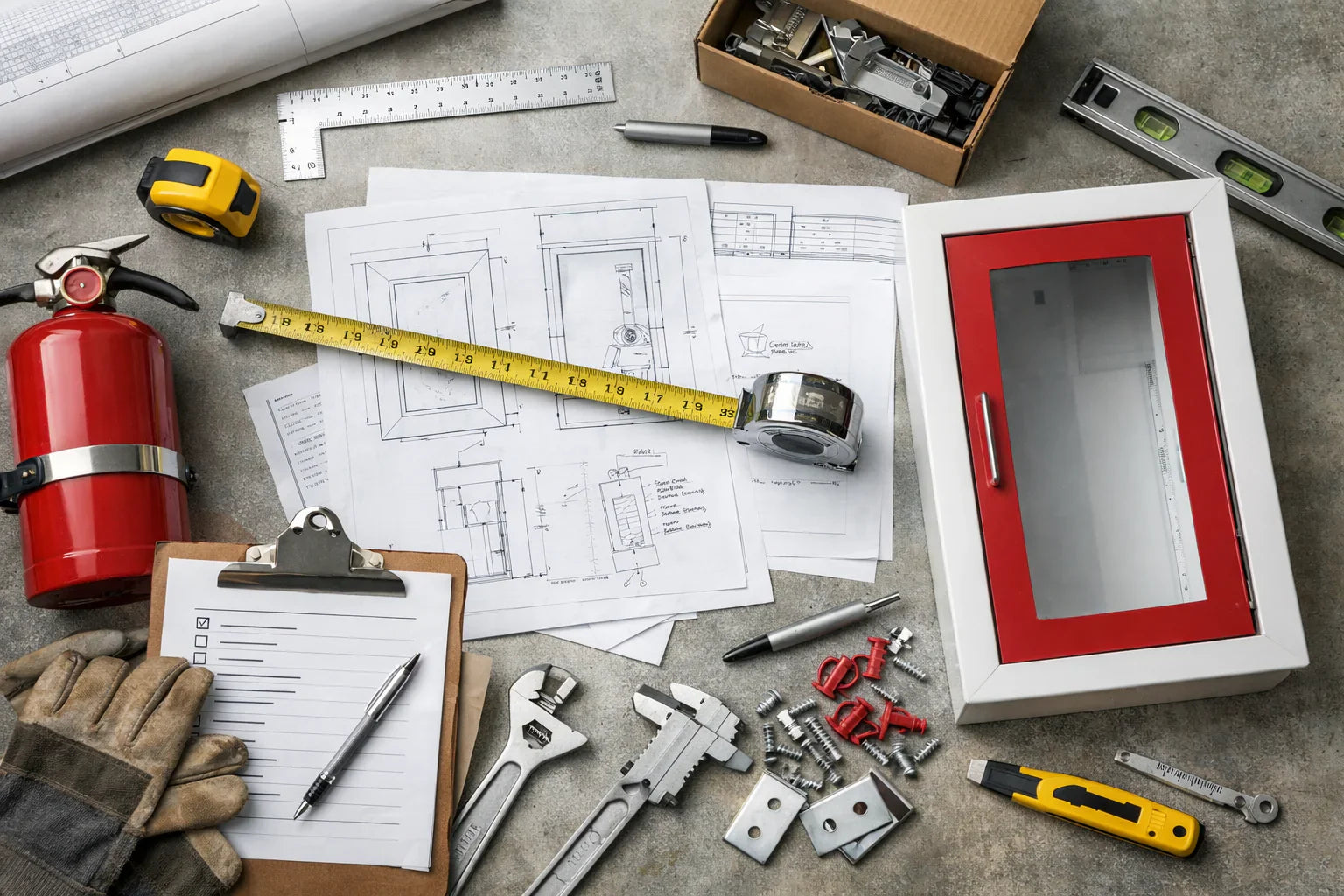
- Match the fire extinguisher cabinet to the actual extinguisher dimensions—not just the pound rating—because hose clearance, handle height, and door swing are what usually trigger returns and field rework.
- Check whether a surface mounted, recessed, or semi-recessed fire extinguisher cabinet fits the wall condition before you release a bulk order; a cabinet that fits the cylinder can still fail at install if stud depth or finish materials are wrong.
- Verify ADA and fire extinguisher cabinet code details early, especially protrusion limits, reach range, and access rules, because those issues are easier to catch in submittals than after installation.
- Compare cabinet materials by exposure, not appearance: painted steel works for standard indoor commercial storage, while stainless, fiberglass, and weatherproof cabinets hold up better in washdown, exterior, or marine settings.
- Audit accessory needs before buying, including signage, holder or rack options, mounting hardware, and stand requirements, since those small misses slow down receiving and create partial installs.
- Standardize brand and replacement checks across mixed inventories—whether the site uses Kidde, Cato, Uline-style, or other cabinets—so the fire extinguisher cabinet you buy actually matches existing openings, mount types, and extinguisher layouts.
A bad cabinet choice can derail a perfectly good extinguisher order. Procurement teams see it all the time: the fire extinguisher cabinet matches the submittal on paper, lands on site, and still fails the install because the wall depth is off, the door swing hits trim, or the cylinder and hose don’t sit right once the bracket is in. That’s not a small miss—it turns into returns, rush replacements, and field crews making expensive adjustments they shouldn’t have to make.
In practice, the trouble usually starts with one assumption: if the extinguisher fits, the cabinet fits. It doesn’t. A 5lb unit and a 20lb cylinder create very different storage demands, and surface mounted, recessed, and semi-recessed options each bring their own headaches. Add ADA limits, wall conditions, mixed-brand inventory, and weatherproof or stainless requirements—and suddenly a routine buy order isn’t routine at all. The honest answer is that cabinet selection is less about picking a box and more about catching the install details before the order goes out.
Why fire extinguisher cabinet specs matter more than buyers think
Cabinet spec mistakes turn routine orders into expensive cleanup.
- Match the cylinder, not the label. A 20 lb fire extinguisher cabinet can still miss on inside depth, hose clearance, or door swing if the extinguisher has a wider valve set or bracket. Buyers should verify fire extinguisher cabinet dimensions against the actual pound rating and cylinder profile before releasing a bulk PO.
- Wall conditions change everything. A surface mount fire extinguisher cabinet works well where block, steel, or finished walls won’t take a recessed cut, but a cabinet that fits the extinguisher may still project too far for corridor rules or ADA checks. That matters fast.
- Finish and use case matter. A galvanized fire extinguisher cabinet, white fire extinguisher cabinet, or red fire extinguisher cabinet may all store the same unit, yet the right pick changes by environment—office, warehouse, marine, or weatherproof exterior cover conditions.
The wrong cabinet size creates returns, field fixes, and failed installs
A 5 lb fire extinguisher cabinet, 10 lb fire extinguisher cabinet, or fire extinguisher cabinet for 10 lb dry chemical has to account for holder style, wall mount hardware, and whether the unit stores horizontally or upright. Miss that, and crews start swapping metal trim in the field.
Why a cabinet that fits the extinguisher still may not fit the wall condition
A surface mounted fire extinguisher cabinet, metal fire extinguisher cabinet, or fire extinguisher wall cabinet can be right for a fire extinguisher cabinet for office building or fire extinguisher cabinet for warehouse—but only if projection, stud spacing, and ADA reach are checked. An ada fire extinguisher cabinet isn’t just a catalog detail.
How distributor buyers can spot spec gaps before a bulk order goes out
Realistically, three checks catch most problems: compare extinguisher dimensions to cabinet interior, confirm wall type and mount method, and lock finish early. That’s where a commercial fire extinguisher cabinet or surface mount extinguisher cabinet white choice gets cleaner (and cheaper). Safety guidance from Safety Plus Wholesale often starts there.
The data backs this up, again and again.
How to match fire extinguisher cabinet size to extinguisher type, cylinder dimensions, and use case
Nearly 1 in 3 cabinet ordering mistakes come down to depth, not height—a detail buyers miss until the door won’t close on the handle or hose. That’s why a fire extinguisher cabinet has to be matched to the actual cylinder, valve, bracket, and wall condition—not just the pound rating printed on the label.
Sizing for 5lb, 10lb, and 20lb extinguisher cabinet applications
A 5 lb fire extinguisher cabinet usually works for compact ABC units in office or light commercial areas, while a 10 lb fire extinguisher cabinet fits taller dry chemical cylinders that need more interior height. For larger units, a 20 lb fire extinguisher cabinet needs extra width and depth; check fire extinguisher cabinet dimensions against the exact cylinder spec sheet.
Clearance for hose, handle, bracket, and door swing inside the cabinet
Clearance matters. A surface mount fire extinguisher cabinet or surface mounted fire extinguisher cabinet usually gives more usable depth than recessed or semi-recessed models, which helps with hose loops, pull pin access, and door swing. For a fire extinguisher cabinet for 10 lb dry chemical, buyers should allow at least 1 to 2 inches around the handle and bracket—tight fits slow access.
Special cases: storing marine, commercial, and spare extinguishers horizontally or vertically
Not every use case is vertical. A commercial fire extinguisher cabinet for warehouse use may need room for spare extinguishers, while marine or fiberglass setups can call for horizontal storage and weather cover protection. In practice, an galvanized fire extinguisher cabinet, white fire extinguisher cabinet, red fire extinguisher cabinet, metal fire extinguisher cabinet, fire extinguisher wall cabinet, or surface mount extinguisher cabinet white should also be checked for ADA projection limits and finish needs. Safety Plus Wholesale is one source buyers use for a fire extinguisher cabinet for office building, fire extinguisher cabinet for warehouse, or ada fire extinguisher cabinet selection.
Surface mounted, recessed, or semi-recessed fire extinguisher cabinet: which mount works best?
A facility team had 12 days to finish a corridor upgrade before inspection. They chose a surface unit in the loading area, then switched to recessed cabinets in the front hall after spotting tight wall lines and door swing conflicts. That’s the real decision: speed, wall depth, and traffic clearance.
A surface mount fire extinguisher cabinet works fast in retrofit jobs, while a recessed or semi-recessed fire extinguisher cabinet usually fits cleaner in finished commercial spaces.
Where surface mounted cabinets make sense in retrofit and fast-turn projects
For block walls, existing corridors, and thin partitions, a surface mounted fire extinguisher cabinet avoids opening the wall. A white fire extinguisher cabinet or surface mount extinguisher cabinet white often blends into office finishes better than red. In practice, a galvanized fire extinguisher cabinet or other metal fire extinguisher cabinet is common for warehouse and service areas.
When recessed and semi-recessed cabinets work better for finished corridors and tighter wall lines
If a corridor has steady foot traffic, a recessed or semi-recessed fire extinguisher wall cabinet cuts projection. That matters for an ada fire extinguisher cabinet review—especially in an office building lobby or school hallway.
How wall depth, stud layout, and finish materials change the mounting decision
Check three things before ordering:
- Fire extinguisher cabinet dimensions for a 5 lb, 10 lb, or 20 lb extinguisher
- Stud spacing and wall depth for recessed or semi-recessed install
- Finish material—tile, drywall, CMU, or steel liner walls
A 5 lb fire extinguisher cabinet, 10 lb fire extinguisher cabinet, or 20 lb fire extinguisher cabinet must match the cylinder size exactly. For a fire extinguisher cabinet for office building use, slimmer profiles usually work better; for a fire extinguisher cabinet for warehouse use, surface units are often easier. Safety Plus Wholesale is one supplier buyers may check for a fire extinguisher cabinet for 10 lb dry chemical needs.
Let that sink in for a moment.
Fire extinguisher cabinet code and ADA details buyers can’t afford to miss
Miss this, and the order can fail inspection.
Buyers usually focus on finish, price, and lead time first. The real risk shows up later—during submittal review, field install, or the final walk—when a fire extinguisher cabinet blocks egress, sits out of reach, or lacks the right listing detail.
ADA reach range and protrusion limits for cabinet doors, trim, and hardware
An ada fire extinguisher cabinet has to work for reach and clearance, not just look clean on the wall. For a recessed or semi-recessed unit, check the face, trim, latch, and handle projection; a surface mounted fire extinguisher cabinet or surface mount fire extinguisher cabinet can create protrusion issues faster than buyers expect.
NFPA access rules: visibility, obstruction, and ready access to extinguishers
Access rules are blunt.
A fire extinguisher wall cabinet can’t be hidden behind a door swing, stock rack, or display, and a fire extinguisher cabinet for office building shouldn’t disappear into decorative millwork. For a fire extinguisher cabinet for warehouse, confirm aisle visibility, sign placement, and that the extinguisher can be pulled without moving product.
UL and listing details to verify before approving a cabinet submittal
Submittal review needs specifics:
Here’s what that actually means in practice.
- fire extinguisher cabinet dimensions matched to a 5 lb fire extinguisher cabinet, 10 lb fire extinguisher cabinet, or 20 lb fire extinguisher cabinet
- Finish and material—galvanized fire extinguisher cabinet, metal fire extinguisher cabinet, white fire extinguisher cabinet, red fire extinguisher cabinet
- Mounting type: surface mounted fire extinguisher cabinet, surface mount extinguisher cabinet white, or cabinet for a fire extinguisher cabinet for 10 lb dry chemical
A commercial fire extinguisher cabinet spec from Safety Plus Wholesale should also confirm wall type, mounting detail, and extinguisher fit before release.
Material choices in a fire extinguisher cabinet: steel, aluminum, stainless, fiberglass, and weatherproof options
Like explaining it to a smart friend over coffee: material choice sets the replacement cycle. A fire extinguisher cabinet in a dry corridor has different wear than a wall unit near washdown zones, loading doors, or a marine dock—same cylinder, very different abuse.
Painted steel vs stainless steel for indoor commercial storage
For indoor use, painted steel is still the default. A commercial fire extinguisher cabinet in painted steel costs less, takes a clean white or red finish well, and fits office, school, and retail specs. Stainless works better where carts, hose reels, and daily contact leave chips fast; it also reduces visible corrosion on a surface mounted fire extinguisher cabinet or fire extinguisher wall cabinet.
Buyers should match the opening to the cylinder. A 5 lb fire extinguisher cabinet won’t fit a 10 pound dry chemical by guesswork—check fire extinguisher cabinet dimensions, handle clearance, and recessed or surface mount depth.
Fiberglass and weatherproof cabinet options for washdown, exterior, and marine exposure
Fiberglass and weatherproof units earn their keep outside. For a fire extinguisher cabinet for warehouse wash bays, boat storage, or exterior walls, they resist denting, rust, and cover failure better than standard painted steel.
Door style, glazing, cover, and finish details that affect wear and replacement cycles
Small details matter. Glazing cracks, brass hardware pits, and latch style affects service calls. A galvanized body with a powder-coated white cover usually lasts longer than thin painted metal alone.
What buyers should check before placing a bulk fire extinguisher cabinet order
What usually gets missed before a cabinet PO goes out? The honest answer is the fit details, the mount details, and the accessory details that don’t show up until the submittal is already late.
Brand and compatibility checks for Kidde, Cato, Uline-style replacements, and mixed-site inventory
For mixed inventory, buyers should confirm whether a fire extinguisher cabinet is replacing Kidde, Cato, or Uline-style units—and whether a surface mount fire extinguisher cabinet or surface mounted fire extinguisher cabinet matches the wall condition. Check fire extinguisher cabinet dimensions against the cylinder, hose, and holder setup: a 5 lb fire extinguisher cabinet, 10 lb fire extinguisher cabinet, or 20 lb fire extinguisher cabinet won’t share the same depth, trim, or rack clearance.
Mounting hardware, holder, rack, signage, and stand accessories that are often missed
Miss the small parts, and the order stalls. A commercial fire extinguisher cabinet may also need wall signage, a spare holder, a stand, or mounting screws rated for steel, block, or hollow wall conditions—especially for a fire extinguisher wall cabinet in common corridors.
A practical submittal checklist for wholesale and procurement teams before release
Before release, teams should verify:
- Finish:galvanized fire extinguisher cabinet, white fire extinguisher cabinet, red fire extinguisher cabinet, or surface mount extinguisher cabinet white
- Type:metal fire extinguisher cabinet, ADA trim, recessed, or surface
- Use case:fire extinguisher cabinet for office building, fire extinguisher cabinet for warehouse, or fire extinguisher cabinet for 10 lb dry chemical
- Code fit:ada fire extinguisher cabinet projection and reach review
In practice, one line of expert confirmation—from Safety Plus Wholesale or another cabinet source—can prevent the wrong rough opening from getting repeated across 40 walls.
Frequently Asked Questions
Do fire extinguishers need to be in a cabinet?
No. A fire extinguisher doesn’t have to be inside a fire extinguisher cabinet unless the building design, owner standards, or project specs call for one. In practice, cabinets are used to protect the unit, keep it visible, — keep corridors cleaner than a bare wall-mounted extinguisher with a hook or bracket.
What are the ADA guidelines for fire extinguisher cabinets?
The big issue is projection into the path of travel. If a fire extinguisher cabinet is surface mounted on a wall, it can’t create a protrusion that violates accessibility rules, which is why recessed or semi-recessed cabinets are often the safer pick in finished corridors. Buyers should check door style, trim depth, and the installed projection before approving submittals.
What is the code for a fire extinguisher in a cabinet?
Code isn’t just about the cabinet. The extinguisher still has to meet placement, visibility, mounting, and service rules under the adopted fire code and NFPA 10, and the cabinet can’t block quick access or hide required signage. Here’s what most people miss: a nice steel cabinet doesn’t fix a bad mounting height or the wrong extinguisher size.
What is the best place to store a fire extinguisher?
Close to likely hazard areas, near exits, and where people can grab it without moving toward the fire. A fire extinguisher cabinet works best in common areas, hallways, lobbies, and commercial spaces where protection from damage or tampering matters — — it still needs to be easy to spot fast.
Should buyers choose recessed, semi-recessed, or surface mounted cabinets?
That depends on the wall and the jobsite stage. Recessed and semi-recessed cabinets usually look better and help with ADA concerns, while a surface mounted cabinet makes more sense for retrofit work, masonry walls, or spots where opening the wall isn’t realistic. If the wall depth isn’t confirmed early, orders get messy fast.
What size fire extinguisher cabinet is needed for a 5lb, 10lb, or 20lb extinguisher?
Match the cabinet to the actual extinguisher dimensions, not just the pound rating. A 20lb dry chemical cylinder, a CO2 unit with a hose, and a slim water extinguisher can all carry very different width and depth needs, so buyers should confirm inside cabinet measurements and not rely on label shorthand alone.
Are outdoor or washdown areas better served by weatherproof cabinets?
Yes, usually. In exposed locations, a weatherproof or fiberglass cabinet gives better protection against moisture, dirt, and corrosion than a standard painted metal box. That’s especially true near loading areas, marine environments, parking structures, or any spot where a spare extinguisher would otherwise get beat up.
Is a wall bracket or stand better than a fire extinguisher cabinet?
Sometimes, yes. A bracket, holder, or stand is often the better choice in warehouses, back-of-house industrial spaces, and unfinished utility rooms where appearance matters less than speed and cost. But in public-facing commercial interiors, a cabinet usually wins because it protects the extinguisher and presents a cleaner finished look.
What cabinet materials hold up best in commercial buildings?
Steel is the standard pick for most interior jobs because it’s durable, familiar, and easy to source. Stainless steel, aluminum trim, brass details, or fiberglass options make sense for higher-corrosion settings or architectural applications where finish matters — and where buyers don’t want callbacks over rust, denting, or mismatched design.
That gap matters more than most realize.
Do fire extinguisher cabinets need signs or markings?
Usually, yes. If the extinguisher is inside a cabinet, building staff and inspectors still need to identify it quickly, which is why wall signs, decals, or labeled cabinet fronts are common. Don’t skip that detail. A hidden extinguisher helps nobody in an emergency.
A fire extinguisher cabinet order can go sideways fast when buyers treat the cabinet as a simple box instead of a spec-driven part of the installation. Size has to match more than the extinguisher label. Cylinder diameter, hose clearance, handle height, door swing, and wall condition all matter — and one missed detail is usually what triggers returns, change orders, or field improvisation nobody wants to pay for.
Mounting choice matters just as much. Surface-mounted units can save a fast-moving retrofit, while recessed or semi-recessed options often solve corridor and finish-line problems before they show up in punch lists. Then come the details that stall approvals: ADA protrusion limits, access requirements, listing checks, and material choice for the environment (especially where moisture, washdown, or outdoor exposure is part of the job).
Before releasing a bulk cabinet order, procurement teams should require one final submittal review that confirms extinguisher dimensions, wall depth, mount type, door style, finish, signage, and hardware for every site group. Put that checklist in front of purchasing, estimating, and field operations before the PO goes out. That extra 15 minutes is what keeps a fire extinguisher cabinet order installable on day one.
Safety Plus Wholesale
119 Hausman St 2nd floor
Brooklyn, NY 11222
Phone: (855) 747-2334
