

VectorMine // Shutterstock
Half of Americans think AI will replace their financial advisor. The reality is more complicated.
If you’ve ever asked ChatGPT whether you should refinance your mortgage or how to allocate your 401(k), you’re not alone. You’re not even in the minority anymore.
A recent survey from Credit One Bank found that more than a quarter of U.S. consumers have turned to an AI-powered app or chatbot for financial advice in the past year. With the rise of popularity, people are finding more uses for AI in their everyday lives.
But here’s where it gets interesting: Despite the rising comfort with AI tools, most people still call their mom first.
Most People Still Trust Humans Over Algorithms
Credit One Bank
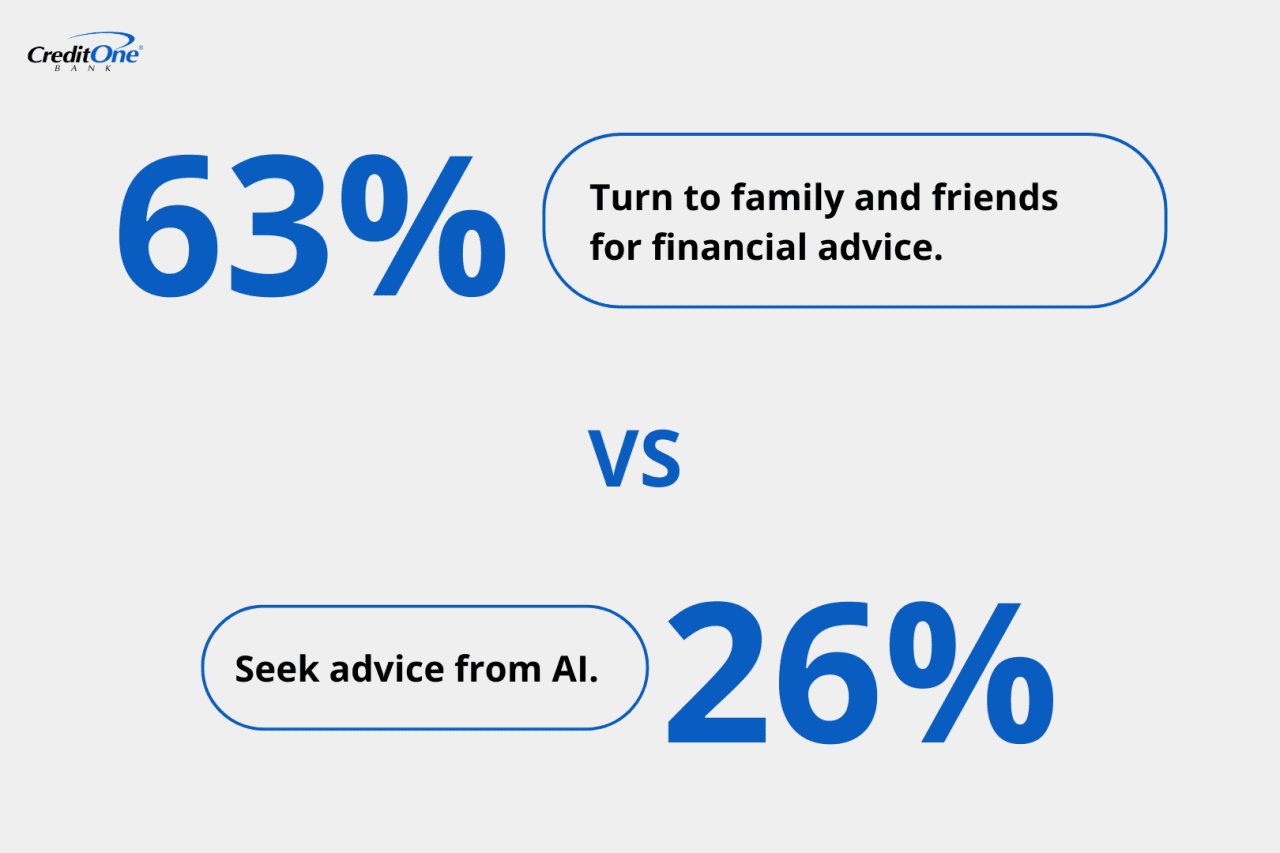
For all the buzz about AI-powered finance tools, the numbers tell a pretty grounded story. Sixty-three percent of respondents said they turned to family or friends for financial guidance in the past year. Only 26% said the same about an AI tool.
That gap matters because money decisions aren’t purely mathematical. They carry emotional weight. A study from Vanguard shows that about 40% of the value an advisor provides their clients is emotional.
When you’re debating whether to drain your savings for a down payment or if you can afford to leave a job, a chatbot can run the numbers but can’t read the room. Your sister-in-law, who went through the same thing last year, can.
That said, most consumers are still in the experimenting phase. They’re open to AI, but they haven’t shifted away from the people they already trust.
1 in 5 Americans Already Let AI Make the Call
Credit One Bank
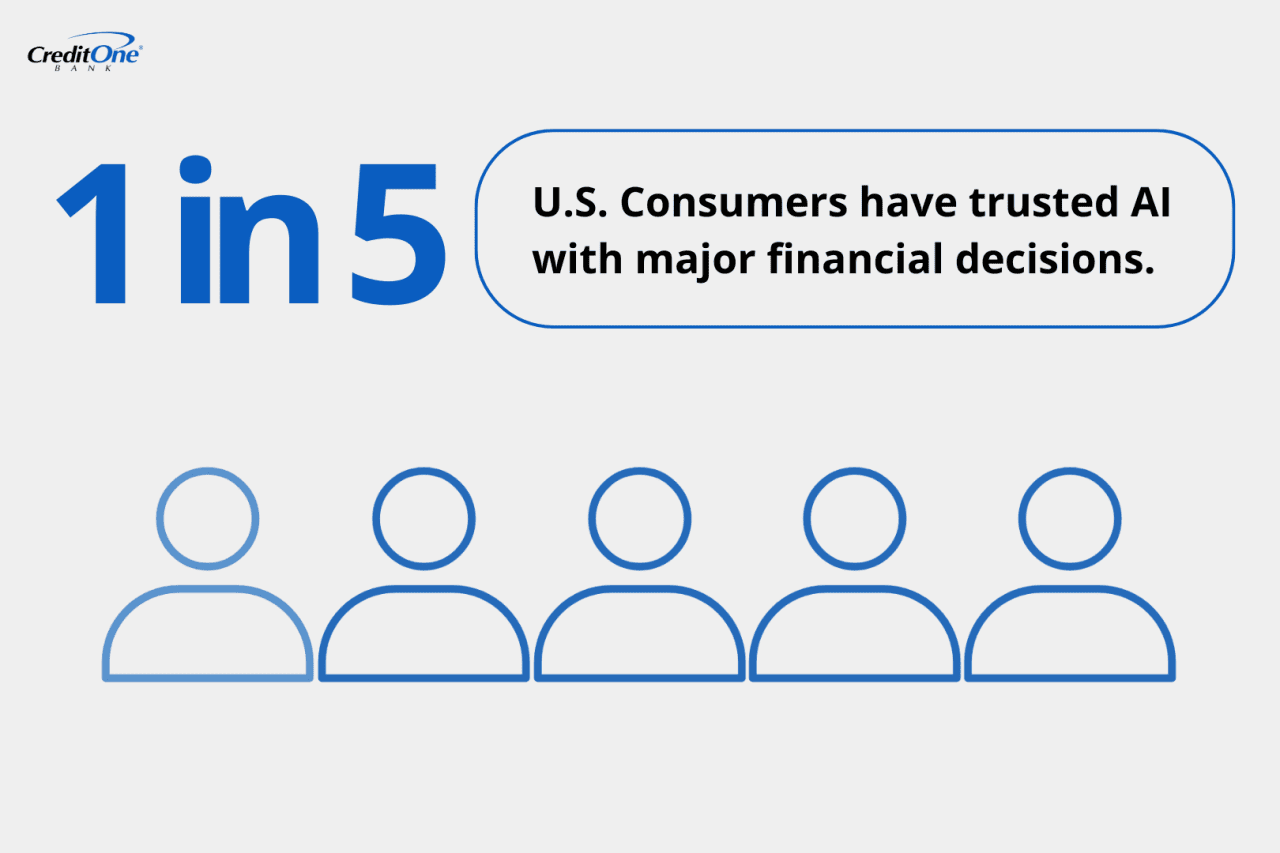
Here’s the stat that should make financial advisors pay attention: 20% of U.S. consumers say they’ve made a significant financial decision based primarily on an AI tool’s recommendation.
Not “looked at what the AI said and then ran it by a professional.” Not “used it for budgeting tips.” One in 5 people let an algorithm lead on a decision that could affect their financial future.
Credit One Bank
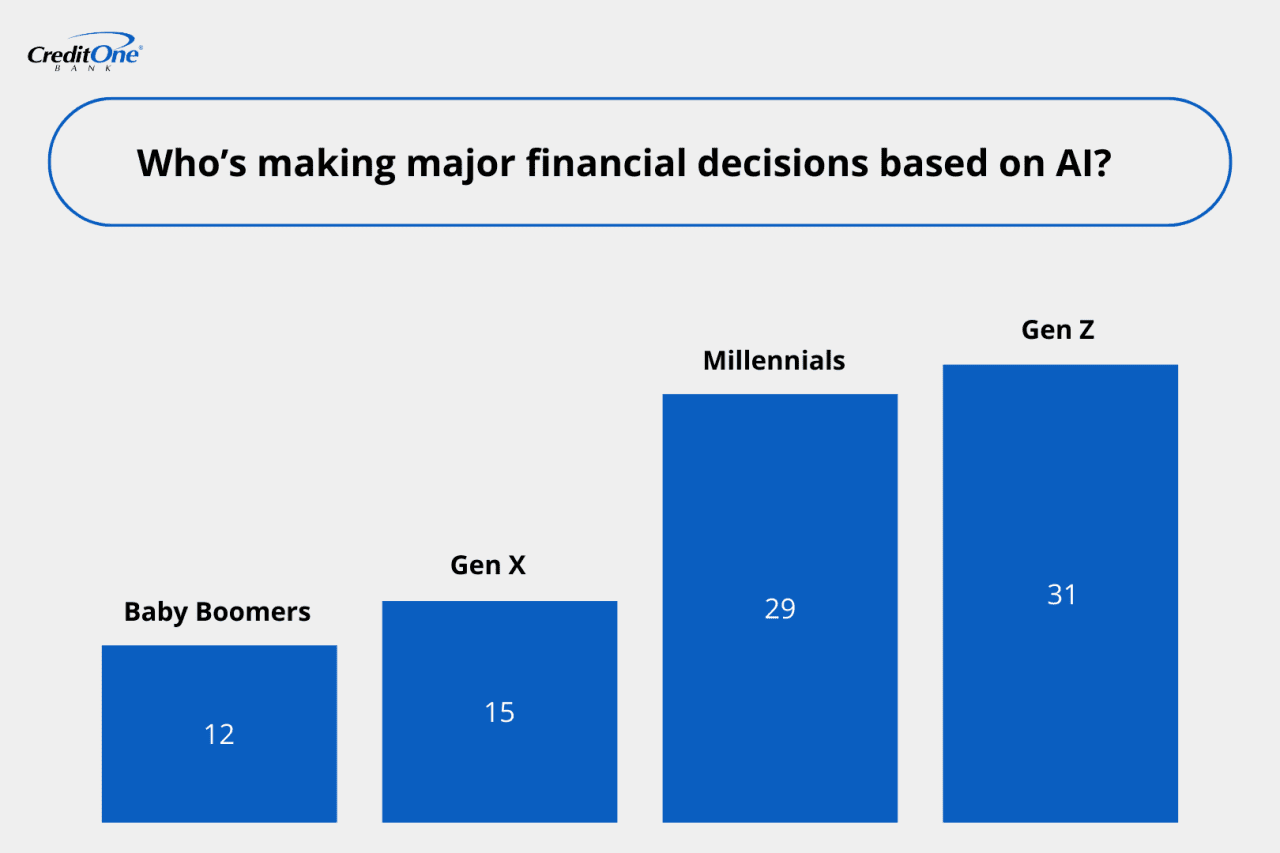
The generational breakdown adds texture. About 29% of Millennials and 31% of Gen Z have done this, compared to just 12% of Baby Boomers. It makes sense, since younger consumers grew up Googling everything from homework answers to health symptoms. Adding “should I invest in index funds” to that list isn’t a stretch.
But even among Gen Z, the most digitally native generation, less than a third have taken this step. Growing up with technology doesn’t mean automatically trusting it with your retirement account.
And when things go wrong? Forty percent of all respondents said they’d hold themselves accountable if an AI-guided financial decision led to losses. People are using the tools, but they’re not passing the blame.
Privacy Is the Biggest Sticking Point
Credit One Bank
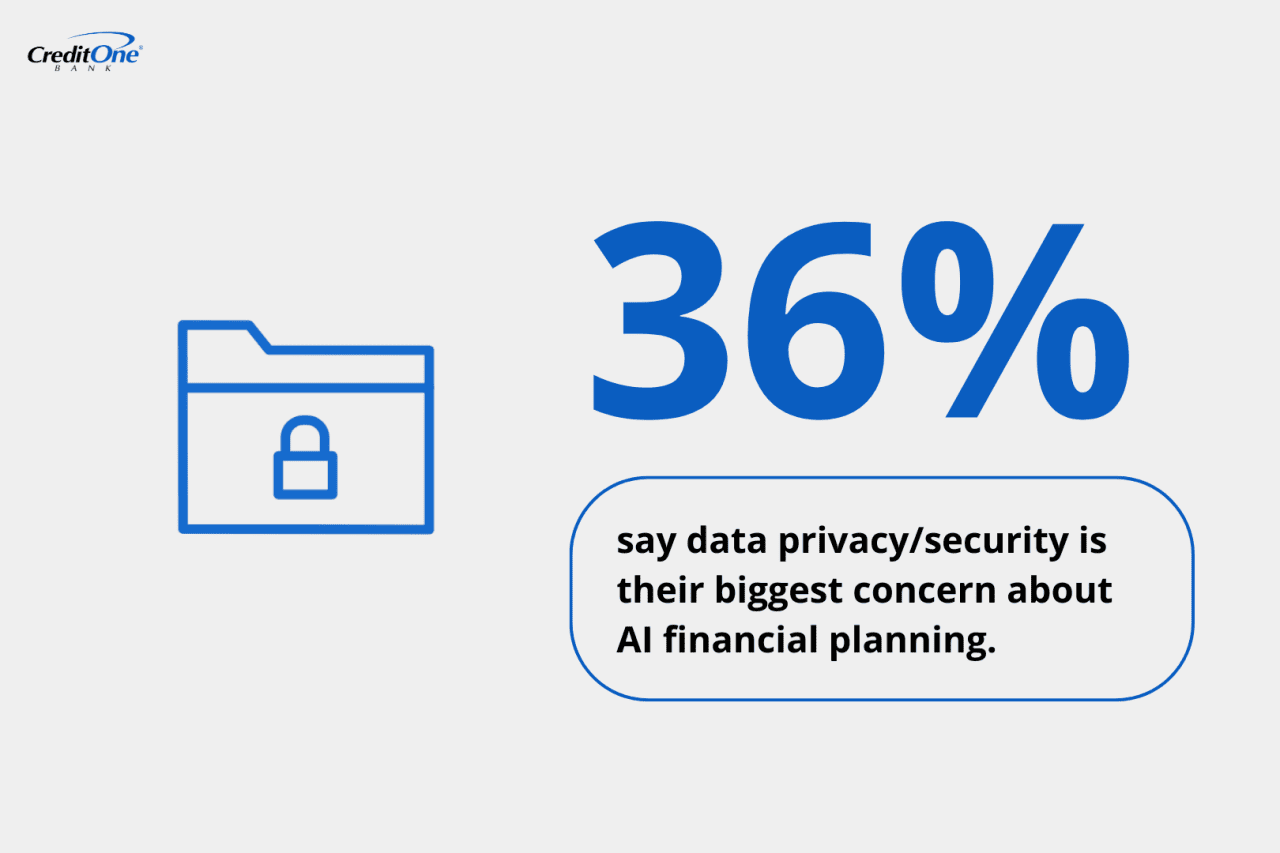
When asked what concerned them most, accuracy wasn’t the top answer, as most would think. Data privacy was, cited by 36% of consumers, with accuracy close behind at 33%.
To truly get personalized financial advice, you’d have to share income, debts, spending habits, investment accounts, maybe your credit score. That’s a lot of sensitive information to hand over to a system you can’t look in the eye.
The gender divide here is telling. Forty-one percent of men said they’d feel comfortable sharing their full financial data with an AI system. Only 25% of women said the same. When asked whether they trust AI more than a human advisor, 15% of men said yes versus 10% of women.
The Harvard Business School also saw this pattern with broader AI adoption. Their research shows women are adopting AI tools at a 25% lower rate than men on average, citing ethical concerns about using the tools.
Taken together, the data suggests the gap between men and women isn’t simply about trusting the technology to work. Women appear to be weighing a broader set of considerations, including whether they should be using these tools at all, before opting in.
The Replacement Question Isn’t as Simple as It Sounds
Credit One Bank
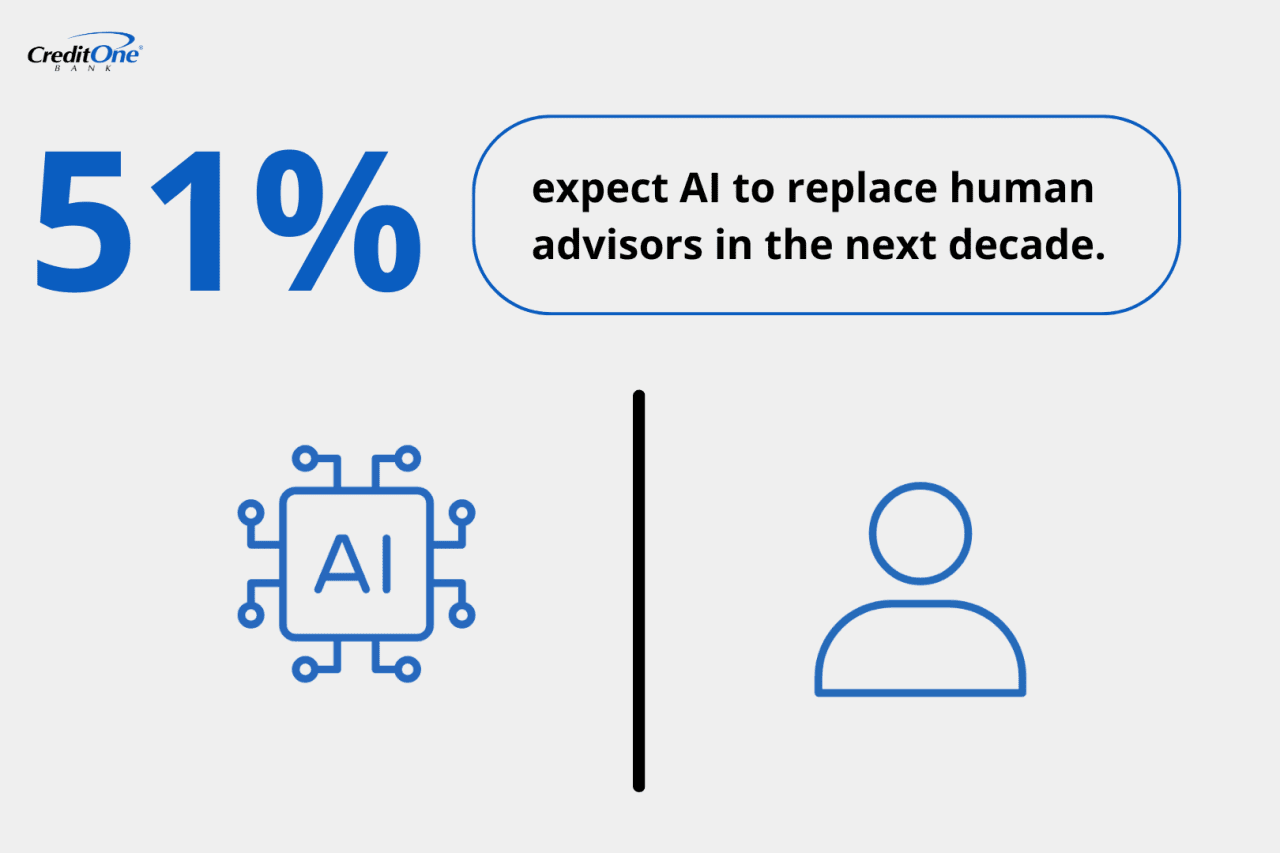
Now for the headline stat: 51% of U.S. consumers believe AI will replace most financial advisors within the next decade. That’s a majority, and it sounds dramatic.
But consumer behavior tells a different story. Only 31% say they’d feel comfortable sharing their full financial data with an AI system today. Half the country expects a replacement, and less than a third is ready to participate. That’s a wide gap between prediction and practice.
Income plays a part in how people see this playing out. Among those earning under $50,000, 55% expect AI to take over. Among those earning $150,000 or more, that number drops to 46%. It makes sense. If you’ve never been able to afford a financial advisor, a free AI alternative sounds like progress. If you already have a trusted advisor managing a portfolio, you’re less likely to see a chatbot as an upgrade.
The workplace angle is worth watching, too. Fifty-four percent of respondents said they’d use an AI financial planning tool if their employer offered it as a free benefit. Part of the reason could be that when a company integrates an AI tool into its benefits package, it signals something beyond a casual recommendation. It suggests the employer has already vetted the platform and trusted it enough to run their own financial operations through it. That kind of built-in proof of concept may do more to lower the adoption barrier than any marketing campaign could.
The 60% who said they’re more likely to trust AI financial advice when it’s backed by a known financial institution seem to reinforce that idea. People may not be waiting for the technology to prove itself on its own. They’re looking for someone else to go first.
So will AI replace your financial advisor? Maybe eventually. But the more accurate prediction is that AI will show up alongside your advisor first, handling the routine stuff while humans stick around for the conversations that actually require one.
Methodology
Credit One Bank surveyed 1,000 U.S. adults nationwide in a survey conducted via Pollfish. Respondents answered questions about where they go for financial advice, how much they trust AI compared to human advisors, whether they’ve acted on AI-generated recommendations, and what worries them most about letting a machine handle their money. Responses were broken down by age, income, gender, and ethnicity to spot patterns across different groups.
This story was produced by Credit One Bank and reviewed and distributed by Stacker.

