

egd // Shutterstock
Car insurance rates by county: The $3,805 gap that decides your premium
Where you live matters as much as how you drive when it comes to car insurance.
CarInsurance.com‘s analysis of full-coverage rates across more than 3,000 U.S. counties found a $3,805 annual gap between the most and least expensive counties in the country.
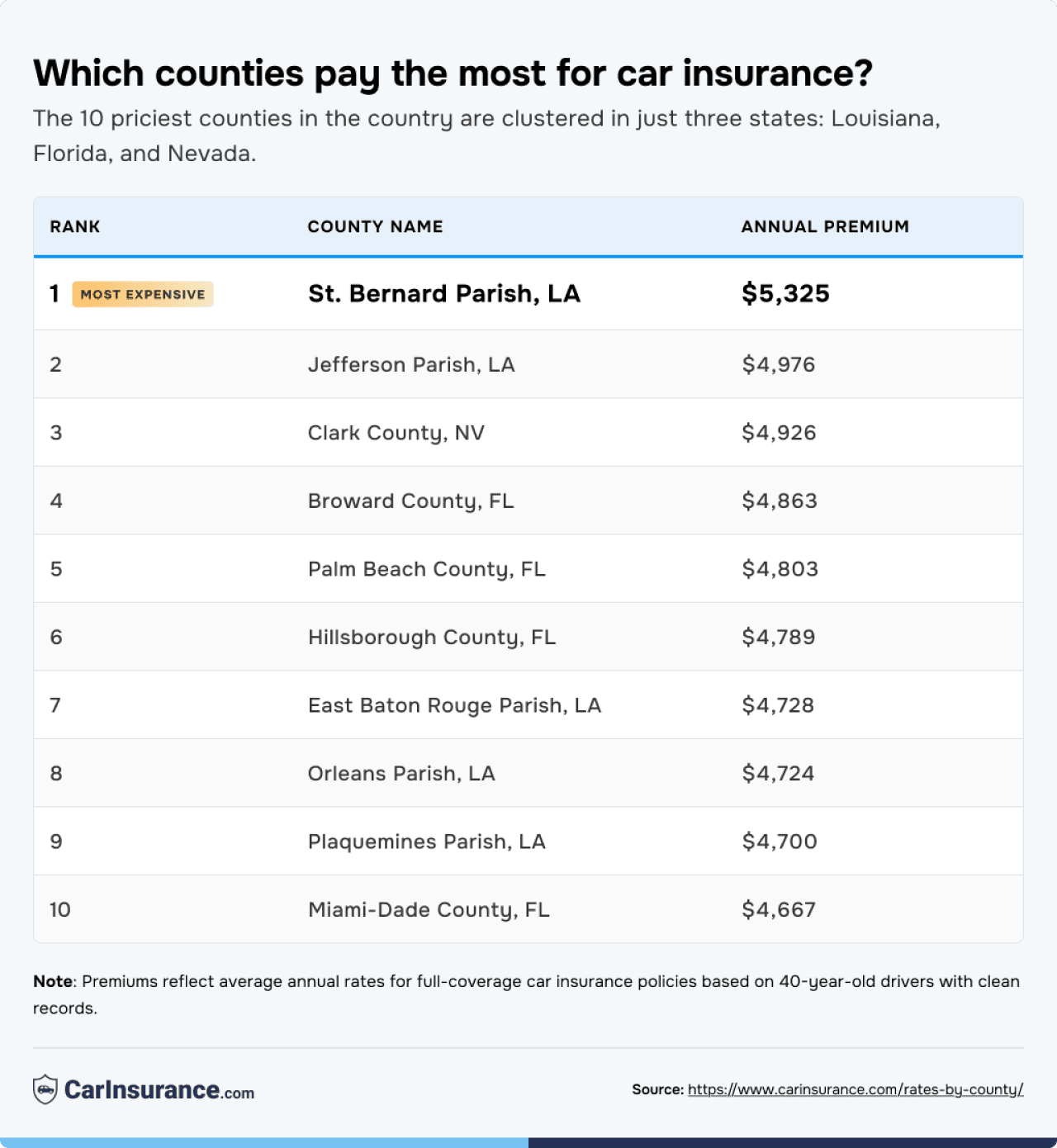
A driver with a clean record pays an average of $5,325 in St. Bernard Parish, Louisiana, and $1,520 in Van Wert County, Ohio, for the same coverage and same driver profile.
That difference is not random.
Insurers price policies using local risk factors tied to where the car is garaged, including traffic density, accident frequency, auto theft rates, uninsured drivers and weather exposure. Those factors can vary sharply from one county to the next.
This analysis shows how counties rank nationwide, why Florida and Texas have some of the widest rate gaps, and what drivers can do to find better prices in high-cost counties. Understanding where your county falls on that range gives you a real benchmark before you shop for car insurance, so you can tell a fair quote from an overpriced one.
Key Insights
- The gap between the most and least expensive U.S. counties for full-coverage car insurance is $3,805 a year: St. Bernard Parish, Louisiana, averages $5,325, while Van Wert County, Ohio, averages $1,520 for the same 40-year-old on the same policy.
- In Florida, Broward, Palm Beach, Hillsborough, and Miami-Dade counties top $4,600 per year for full coverage car insurance.
- Your county’s accident history, theft rate, weather exposure, and uninsured driver share are priced into your base premium before your driving record is ever considered.
- Inside the same county, the gap between the cheapest and most expensive insurers for identical coverage routinely exceeds $1,000 a year.
Do car insurance prices vary by county?
Yes. Car insurance rates can vary by hundreds or even thousands of dollars a year from one county to the next, even for the same driver, vehicle, and coverage.
Insurers group ZIP codes into rating territories that often follow county lines, then assign each territory a base risk level using local accident data, theft frequency, uninsured-driver concentration, and weather exposure.
A 40-year-old with no violations can move two counties over and watch the quote move by hundreds — sometimes thousands — of dollars.
“Location is among the numerous rating factors auto insurers use to price policies,” said Mark Friedlander, senior director of media relations for the Insurance Information Institute (Triple-I).
“Location-specific factors include accident frequency and severity, vehicle crime rates, escalating costs of repairs and medical treatment, and uninsured/underinsured motorist rates. In most states, policy rating is done at the ZIP code level.”
Understanding what drives rates in your county can help you tell whether a high quote reflects local risk or whether another insurer may offer a better price.
Four county-level risk factors shape your base rate:
- Traffic density: Counties with major metro highway systems have far higher rates than rural counties in the same state. Harris County, Texas (Houston), and Wayne County, Michigan (Detroit), are textbook examples.
- Auto theft: Counties with high vehicle theft volume have higher comprehensive premiums. The National Insurance Crime Bureau tracks this data at the metro level.
- Uninsured motorist concentration: Florida’s statewide uninsured rate is 20.4%, according to the Insurance Information Institute. Urban Florida counties run higher still, and that gets priced in.
- Weather exposure: Gulf Coast counties carry hurricane and flood risk; North Texas counties carry hail risk. Both affect comprehensive premiums.
A note on regulated states: California, Hawai‘i, Massachusetts and Michigan restrict which factors insurers can use in personal auto pricing. County variation still exists in those states, but it is compressed compared to states like Florida, Louisiana and Texas.
Counties with the highest and lowest car insurance rates
The $3,805 spread between the most and least expensive counties in the country is the widest gap in personal auto pricing. The most expensive counties cluster in Louisiana and Florida — two states with high uninsured rates, severe weather exposure, and elevated litigation costs. Nevada’s Clark County also has high auto insurance rates.
“These three states are heavily impacted by legal system abuse and rank among the top states for litigated auto claims in the U.S.,” Friedlander said. “This is being driven by billboard attorneys who falsely promise large rewards to consumers if they file lawsuits instead of trying to settle a claim with an insurer after an auto accident. All three states also have an above-average level of accident frequency and severity.”
The least expensive counties cluster in rural Ohio, where traffic density, theft frequency and catastrophe exposure are low.
Most counties’ rates are between these two extremes. Finding where yours sits is the benchmark that tells you whether your own quote is in line.
10 most expensive U.S. counties for car insurance
CarInsurance.com
The 10 most expensive counties in the country are clustered in Louisiana, Florida, and Nevada.
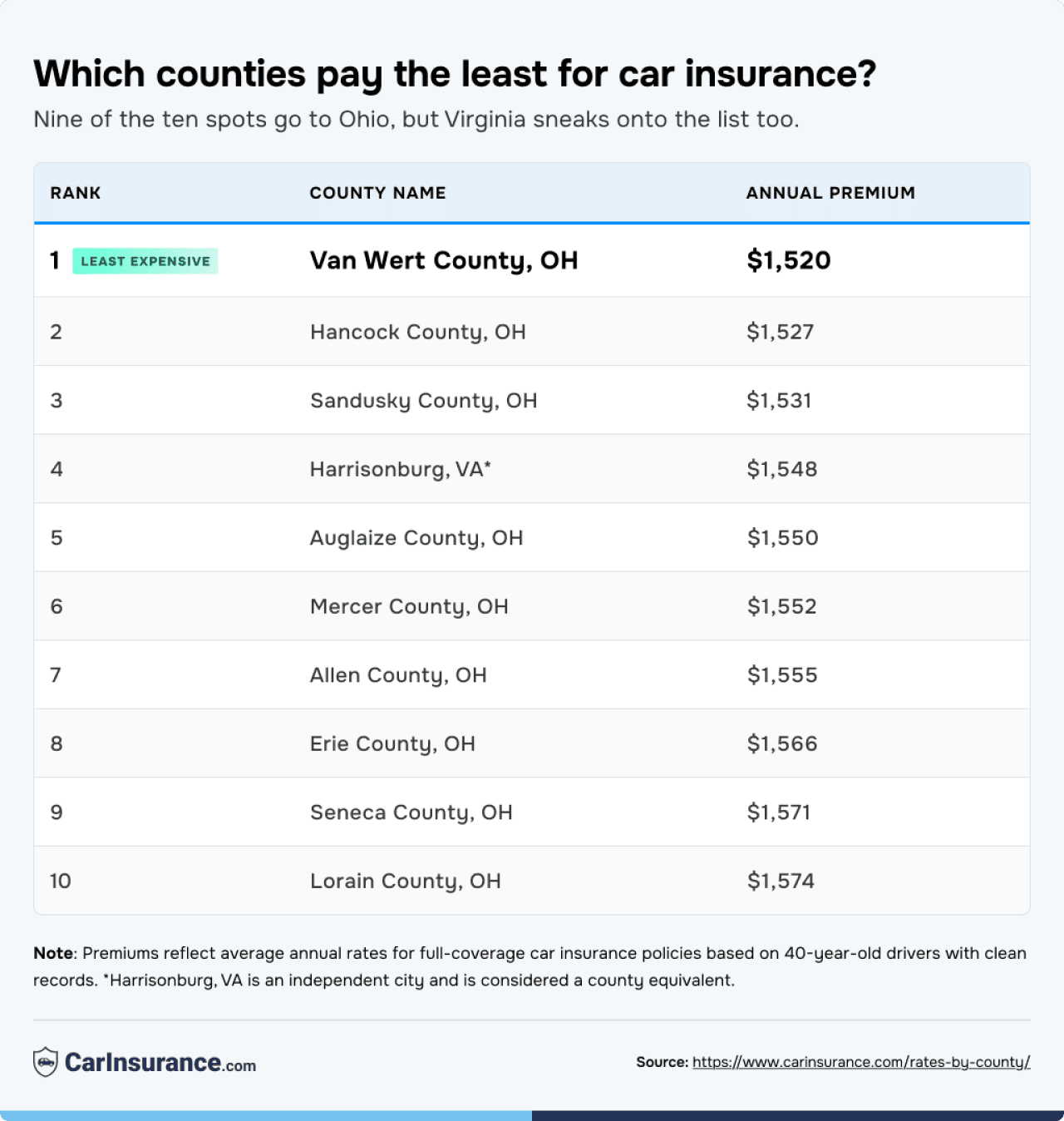
10 least expensive counties for car insurance
The 10 cheapest counties in the country are clustered in Ohio, with one Virginia county included.
CarInsurance.com
State, county, city, ZIP code: how location pricing works
State averages tell you whether your state is generally expensive or affordable. Your county fills in the local context that determines whether a given quote makes sense where you live. Insurers group ZIP codes by local pricing factors that often follow county lines, and changing counties can move your quote by hundreds of dollars a year.
Crossing a county line — even when the city or town name doesn’t change — can reassign your policy to a new rating territory. That holds true inside metros as well: A Tampa address in Hillsborough County is priced differently from a neighboring address in Pasco County, even though it’s just a short drive away.
Smart shoppers get an estimate of their average rate before requesting actual quotes. This gives you a realistic baseline, since coverage costs can differ significantly even within the same state. You don’t need an agent or a phone call to get a ballpark estimate. Online calculators do it instantly — enter your ZIP code and age, and check car insurance rates by ZIP code to get an estimated premium in seconds, without handing over any personal contact information.
Florida car insurance rates by county
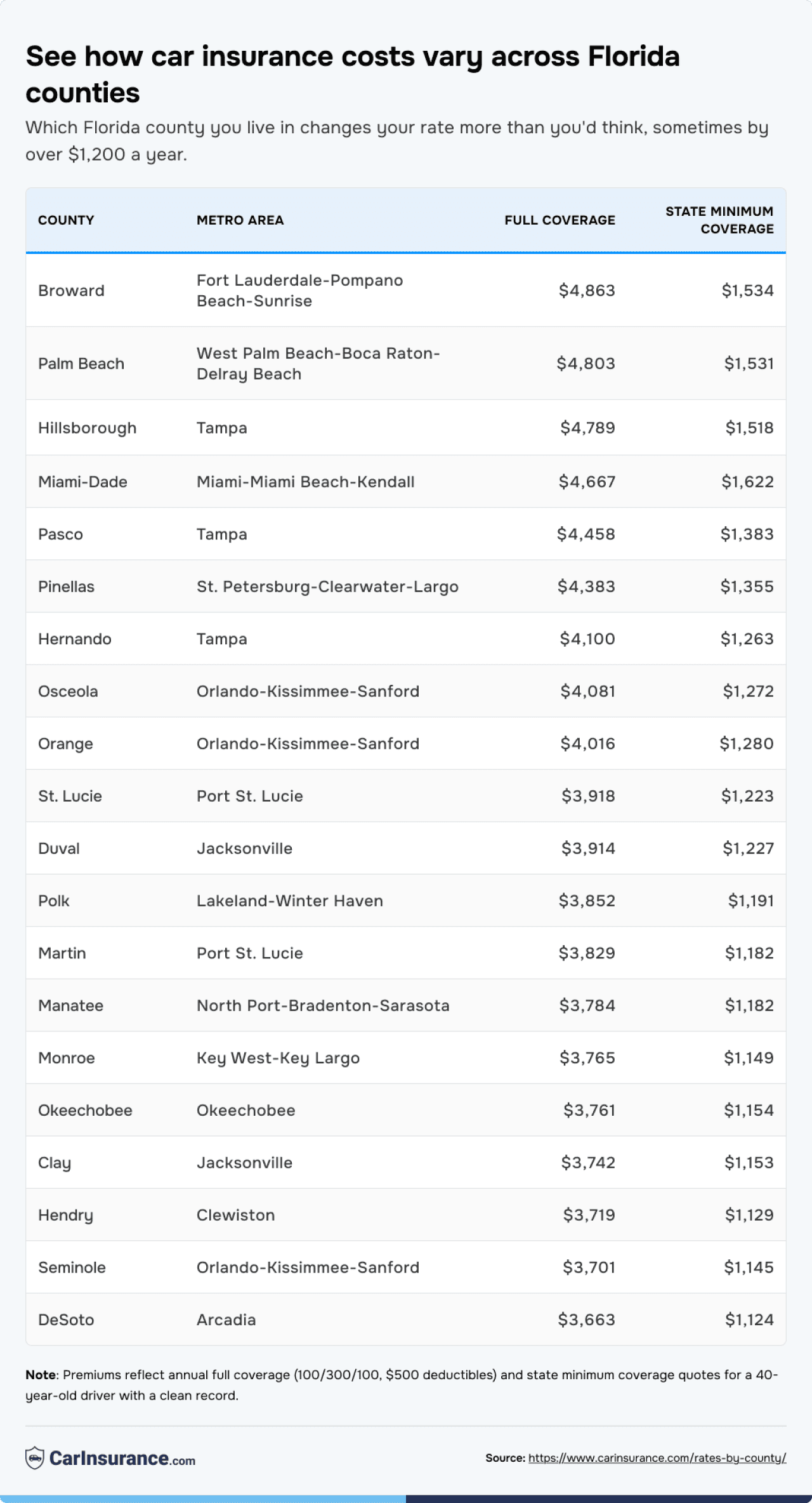
Florida’s county spread is one of the widest in the nation. Broward County averages $4,863 a year for full coverage — the most expensive in the state — while DeSoto County in inland south central Florida averages $3,663 — a $1,200 gap between the most expensive and cheapest counties of the top 20, based on CarInsurance.com’s data analysis.
Friedlander said numerous factors affect the cost of auto insurance in Florida.
“These include very congested highways; a high accident severity and fatality rate; an excessive number of claim fraud schemes, including the third-highest volume of staged accidents in the U.S. and glass replacement schemes; escalating costs of vehicle repairs and medical treatment; severe weather hazards; and legal system abuse, which has generated the highest volume of litigated auto claims in the country,” he said.
Three factors drive Florida’s county-level pricing:
- Florida is a no-fault state: Personal injury protection (PIP), which covers your medical costs after an accident regardless of fault, is mandatory. PIP claims vary sharply by county, and that variation gets priced into your base rate.
- PIP fraud concentration: South Florida’s urban counties — Miami-Dade, Broward and Palm Beach — have a documented history of PIP fraud activity, which pushes up premiums across the South Florida cluster.
- Hurricane and flood exposure: Coastal counties — Monroe, Broward, Palm Beach, Miami-Dade, Pinellas, Hillsborough — carry catastrophe risk that inland counties do not. Comprehensive premiums reflect that.
CarInsurance.com
“Fortunately, the Florida Legislature took significant actions to address legal system abuse and assignment of benefits claim fraud. As a result, the top five auto insurance groups in Florida (Allstate, GEICO, Progressive, State Farm and USAA), which account for nearly 80% of the Florida market, have filed for multiple rate reductions over the past 18-24 months, resulting in double-digit average statewide rate decreases,” Friedlander said. “Numerous other national and regional auto insurers in Florida have followed suit. This is due to a significant reduction in frivolous lawsuits and illegitimate glass replacement claims.”
Texas car insurance rates by county
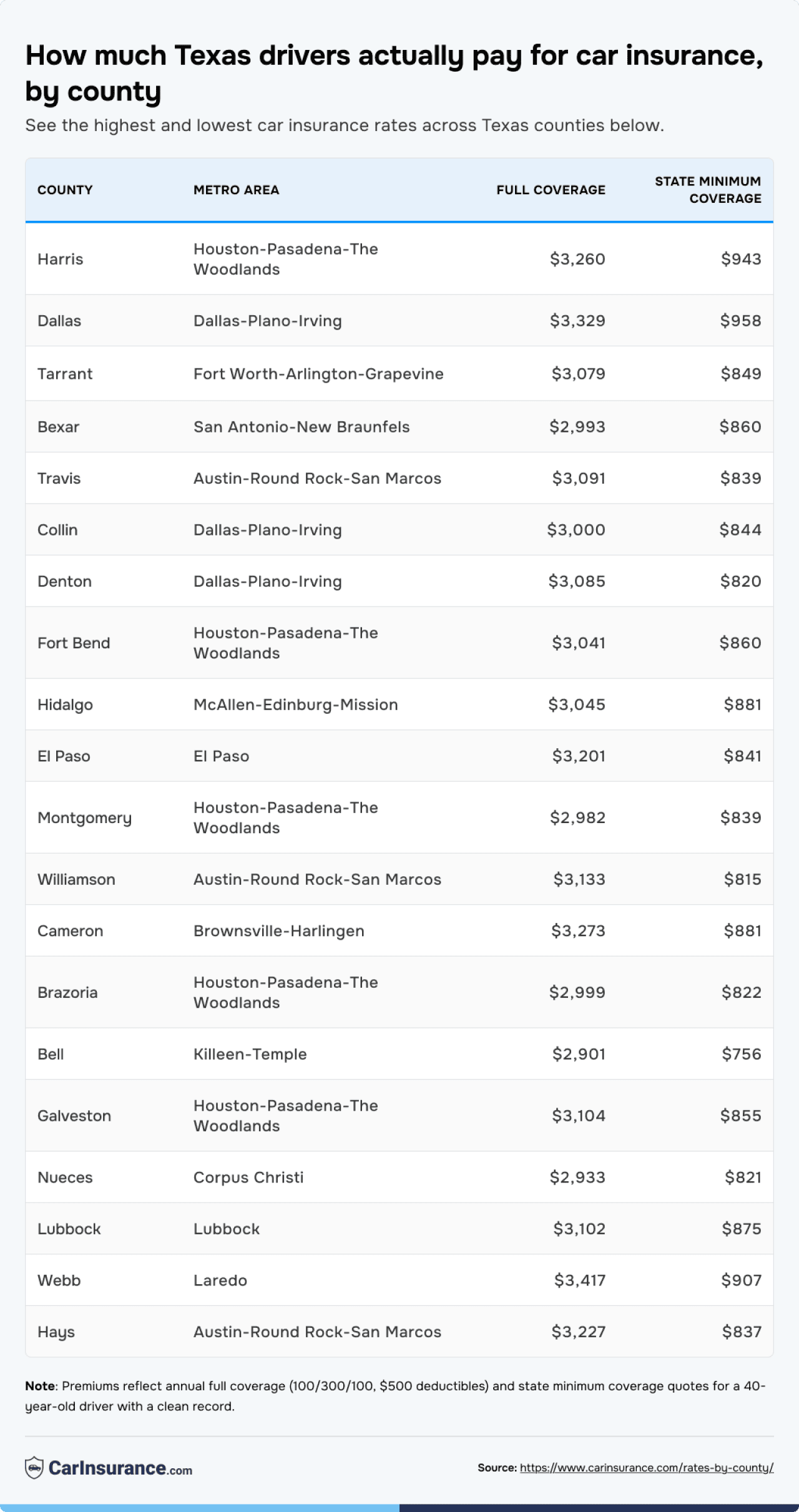
Texas has 254 counties and one of the country’s widest within-state ranges. Among the most-populated counties and metro areas, Webb County (Laredo) averages $3,417 a year for full coverage at the high end, and Bell County (Killeen-Temple) averages $2,901 at the low end of that group — a $516 gap before accounting for rural counties further west and into the Panhandle, which drop further.
1. Webb County: Laredo’s location on the U.S.-Mexico border brings heavy passenger and commercial traffic through its international bridges, increasing congestion and accident exposure on local roads. Insurers also consider ZIP-level claims, theft and repair costs, so higher local losses can contribute to higher premiums.
2. Harris County (Houston) and Dallas-area density: Harris County averages $3,260, and Dallas County averages $3,329 per year for full coverage. Traffic density, claim frequency and Texas’s historically high vehicle theft volume contribute to expensive car insurance rates in Dallas and Houston, as reported by the National Insurance Crime Bureau.
3. Gulf Coast hurricane exposure: Galveston, Harris, Brazoria and Cameron counties all sit on or near the Gulf Coast and carry catastrophe exposure that inland counties do not.
4. North Texas hail risk: Tarrant County (Fort Worth) at $3,079 and Denton County at $3,085 both face the recurring hail exposure of the Interstate 35 corridor, which increases comprehensive premiums.
5. Open-competition rate filing: The Texas Department of Insurance does not require prior approval for a carrier to file a rate change. Carriers can adjust more quickly than in most states, which means that within-county insurer variation in Texas is wider than the national norm. Comparing multiple insurance carriers matters more here than almost anywhere else.
The table below shows the rates for the most expensive and cheapest counties in Texas.
CarInsurance.com
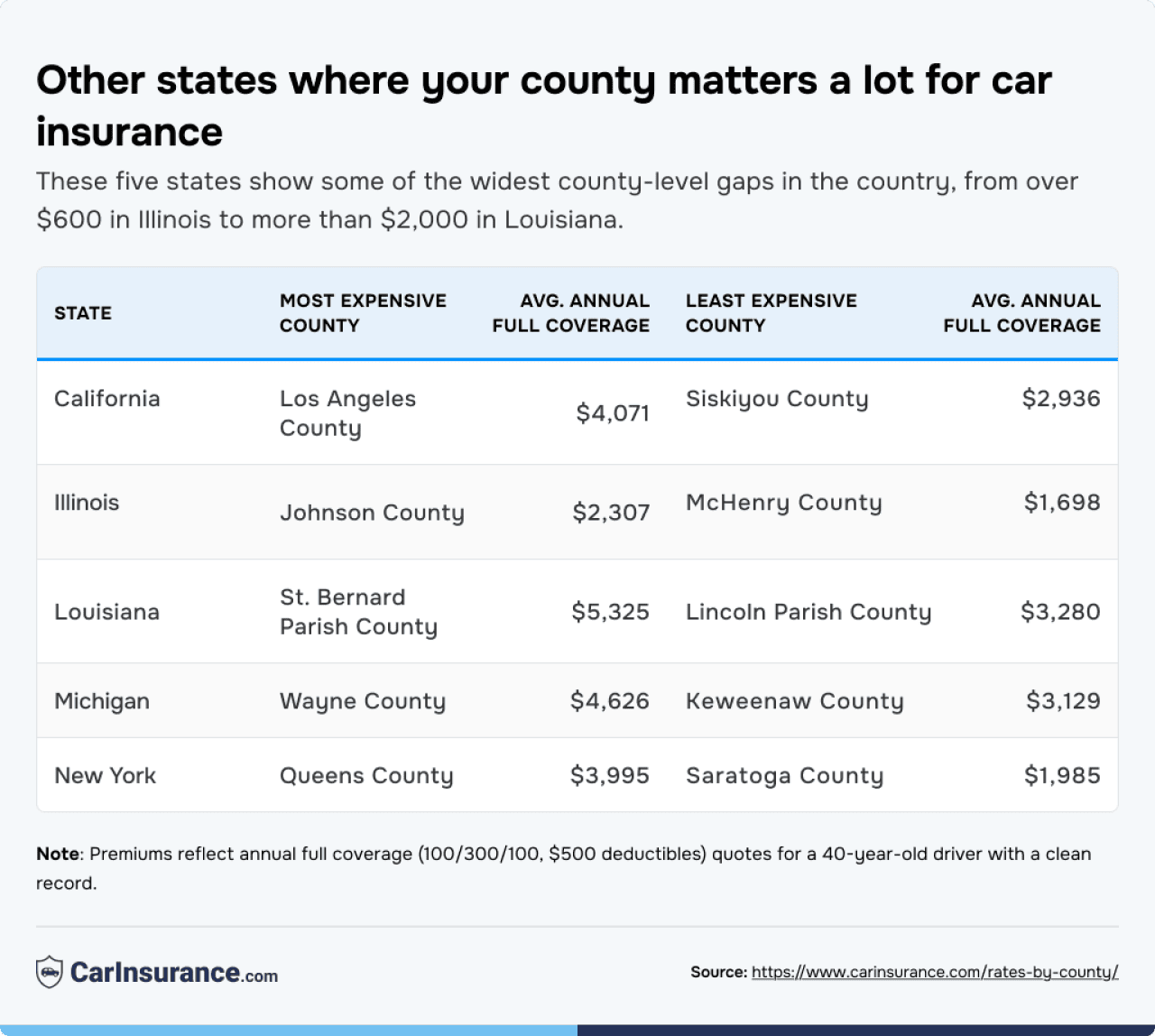
Other high-variation states — the most and least expensive counties
Five additional states show meaningful county-level spread. The pattern is consistent: urban or coastal counties top the state, rural counties anchor the bottom. Louisiana’s within-state spread is the steepest in the group.
CarInsurance.com
What drives car insurance rates up in your county?
If your county’s rate looks high, one of five things is usually driving it. The Wayne County, Michigan (Detroit), average of $4,626, and the Harris County, Texas (Houston), average of $3,260, both trace back to metro traffic density and the claim frequency that comes with it.
Theft is another lever. The National Insurance Crime Bureau publishes county-level data each year, and high-theft counties see comprehensive premiums rise.
Uninsured drivers push rates up where they concentrate, which is why Florida’s 20.4% statewide rate shows through in Broward, Miami-Dade, and Hillsborough.
The weather does the rest along the Gulf Coast and across North Texas. And in litigation-heavy areas like South Florida and Orleans Parish, Louisiana, higher bodily-injury settlements feed back into everyone’s base premium.
Most of these are outside your control. The insurer you pick within your county isn’t — and that’s where the savings actually live.
What happens to your car insurance when you move counties?
Moving counties almost always changes your rate, sometimes by hundreds or thousands of dollars a year. Your new address triggers a rerating in your new rating territory, even if you keep the same carrier and coverage. Three scenarios cover most moves.
1. High-cost county to low-cost county: A move from Miami-Dade ($4,667 average) to Marion County in inland north-central Florida cuts your full-coverage premium by hundreds of dollars on identical coverage.
2. Low-cost county to high-cost county: The reverse hits harder than people expect. Moving from a rural Ohio county at $1,500 to a Louisiana parish at more than $4,700 can triple your premium overnight, even with a clean record.
3. Same county, different ZIP: Even within a single county, ZIP-level boundary changes can shift your rate. A move from one Tampa-area ZIP to another inside Hillsborough County can change your premium by tens to low hundreds of dollars.
Three steps to handle a county move:
1. Pull a quote for the new address before you sign a lease or close on a home. Insurance cost is part of your true cost of living. Get the number before you commit.
2. Notify your current insurer within 30 days of the move. Most carriers require it. Delayed notification can mean a coverage gap or a retroactive premium adjustment.
3. Reshop at the new address. The carrier that was cheapest in your old county may not be the cheapest in your new one. Competitive order changes territory by territory.
“Insurance premiums are priced at the ZIP code level, so a county move can shift your costs more than most buyers and renters expect. It’s worth pulling quotes for any address you’re seriously considering before you commit,” said Brent Buell, lead data analyst at CarInsurance.com.
How to get the best rate in a high-cost county
Five strategies that work specifically inside high-cost rating territories:
1. Compare quotes from multiple insurers. Shop around and compare quotes from at least three to five insurers in your county. Rates can vary widely from one company to another, and the cheapest insurer statewide may not be the best deal where you live. Travelers and GEICO are often among the lower-cost, widely available options, while USAA may offer even lower rates for eligible military families. The only way to find your best price is to compare quotes using your address and driver details.
2. Match your coverage to your county’s actual risk. In a high-theft county, comprehensive coverage earns its premium. In a low-theft rural county with an older paid-off vehicle, minimum coverage may be appropriate. Pay for the risks your county actually presents.
3. Test a telematics program if your driving outperforms your county’s average. Programs like Progressive Snapshot or Allstate Drivewise track driving behavior and offer discounts to safer drivers. The discount tends to be larger in high-base-rate counties because the dollar value of a given percentage off is higher.
4. Bundle auto with home or renters. Bundling discounts run up to 14% at major carriers. In a $4,700 county, that is several hundred dollars a year, meaningfully more than the same percentage off a $1,600 rural premium.
5. Reshop at every renewal. Carrier rate filings change frequently, especially in open-competition states like Texas. The cheapest insurer in your county today may not be the cheapest at your next renewal.
Frequently Asked Questions: Rates by county
Do car insurance prices vary by county?
Yes. Insurers group ZIP codes into rating territories that often follow county lines, then price each territory using local accident history, theft frequency, uninsured driver share, and weather exposure. The same driver on the same coverage can see a quote change by hundreds — or in extreme cases, thousands — of dollars a year just by crossing into a different county.
What county has the cheapest car insurance?
Van Wert County, Ohio, averages $1,520 a year for full coverage — the lowest in the country in this analysis. Nine of the 10 least expensive counties are in Ohio, with the 10th being Harrisonburg, Virginia, at $1,548 — an independent city that functions as a county equivalent for insurance rating purposes. The pattern reflects low traffic density, low theft volume and limited catastrophe exposure in rural Ohio.
What county in Florida has the highest car insurance rates?
Broward County leads Florida at $4,863 a year for average full coverage, followed by Palm Beach ($4,803), Hillsborough ($4,789) and Miami-Dade ($4,667). The South Florida cluster, combined with Tampa Bay, accounts for the state’s most expensive county-level rates.
What company actually has the cheapest auto insurance in a high-cost county?
Travelers and GEICO are the most consistently cheap and widely available carriers across high-cost counties, though the order varies by county. USAA, available only to military members and their families, often prices below those of all major insurers. The right answer for your county is to pull quotes from at least three to five carriers in your own ZIP code — county order is not state order, and statewide cheapest-carrier rankings can mislead at the county level.
The bottom line
Where you live helps determine your starting rate, but the insurer you choose and how often you compare quotes can make a big difference in what you ultimately pay. Start by checking the average rate for your ZIP code, then compare quotes from three to five insurers that offer services in your county. Shopping around can lead to greater savings than adjusting one coverage feature or discount at a time.
Methodology
CarInsurance.com conducted a comprehensive analysis using billions of data points to provide accurate, insightful information on how rates vary from one county to another.
To ensure consistency, calculations were based on male and female drivers aged 40 carrying a full coverage policy, with limits of 100/300/100 and $500 collision/comprehensive deductibles. The driver has a 12-mile commute, an annual mileage of 10,000 miles, and maintains a clean driving record with no accidents or violations.
This story was produced by CarInsurance.com and reviewed and distributed by Stacker.

