


PIDCO.Art // Shutterstock
How to structure an accounts payable department by company size and stage
At 30 employees, one person handling QuickBooks worked fine for the accounts payable department. But at 150, that same setup becomes a month-end bottleneck. Invoices pile up in a shared inbox. Approvals live in Slack threads that nobody can reconstruct. Your auditor asks about the separation of duties, and you’re piecing together an answer on the spot.
If you’re a VP of finance at a company that’s growing faster than its finance infrastructure can keep up with, this is the moment AP stops being a background function and starts being a liability.
The issue usually isn’t the people. It’s more so that the AP function was gradually pieced together over time. To get to a function that scales as your organization grows, prioritize your process and controls before adding headcount. This guide from Brex walks you through exactly how to do that. More specifically, this guide covers the following.
- What AP actually owns and where it breaks first under growth pressure
- What changes at each company size, from 50 to 500 or more employees
- How to structure the team and controls at each stage
- The five controls that keep your AP function from breaking under growth pressure
Key takeaways
- AP functions often break as companies scale because they weren’t deliberately structured, and growth exposes the workarounds that got added along the way.
- The order in which you build matters just as much as what you build. Focus on standardizing processes and enforcing controls before adding headcount.
- AP functions generally hit the same growth inflection points. Knowing where you’re at, and what typically breaks next, lets you get ahead of bottlenecks before they affect close.
- To get the hire-versus-automate decision right, you’ll need to understand whether your bottleneck is due to volume or process friction.
What is an accounts payable department?
The accounts payable (AP) department is the part of your finance team responsible for managing and paying your company’s outstanding vendor invoices, from receipt through payment clearance. It touches month-end close, cash flow forecasting, and audit readiness all at once. That’s why AP tends to feel growth pressure before the rest of the finance org does, and why a breakdown there rarely stays contained to one area.
The 5 core functions of an accounts payable department
AP generally owns five core functions. Under normal conditions, they run in the background. But under growth pressure, any one of them can become the reason close takes longer than it should, an audit finding surfaces, or a duplicate payment slips through. Knowing which functions are under strain and why tells you whether your next move should be a hire, a process fix, or a better tool.
Invoice validation at intake
AP is often the first line of review for billing errors, duplicate invoices, and fraudulent submissions. Every invoice should clear completeness checks, duplicate detection, and matching against purchase orders (POs) or contracts before it reaches a general ledger (GL) account or an approver. When intake is scattered across email, Slack, and paper mail with no central channel, these reviews don’t happen consistently. Duplicates slip through and surface at reconciliation, which is the worst possible time for the controller to find them.
GL coding in accounts payable
GL coding is AP’s direct contribution to close accuracy. Every invoice needs to land on the right GL account, cost center, department, and project before it reaches the controller. When coding is manual and rule-free, the controller often spends the first few days of every close correcting miscoded entries that distort departmental spend reports. Invoice matching catches what coding misses, reconciling invoices against POs and confirming payment covers delivered goods and services. Auditors treat two-way matching as a standard control, so gaps here tend to surface quickly under scrutiny.
Approval routing
In many companies, AP owns the workflow from validated invoice to paid. The team routes each invoice to the right approver based on amount, department, and vendor type, collects approval, then executes payment on the right schedule. When that workflow lives in email threads and Slack messages, approval backlogs can extend close by days and the AP team ends up chasing confirmations instead of processing invoices.
For companies managing AP across multiple entities or locations, the problem compounds quickly. The same invoice can sit waiting on approvers in three different time zones with no visibility into where it’s stuck. But with vendor payment automation, teams can recover that capacity without adding headcount.
Vendor master management
The vendor master is the record of every vendor your business pays, including supplier names, bank details, tax identifiers, and payment terms. AP owns this, which also means it owns the onboarding of new vendors, updates to bank details, and verification that every payment goes to a legitimate recipient.
That last responsibility is where the highest fraud risk in the entire AP process lives. AFP’s 2025 Payments Fraud and Control Survey found that vendor imposter fraud, where attackers pose as a legitimate vendor to redirect payments through fraudulent bank-detail changes, was cited by 45% of organizations in 2024, an 11-percentage-point increase from the prior year. For companies managing multiple entities, the exposure multiplies. More vendors mean more bank-detail updates and more opportunities for a change to slip through without a second set of eyes to verify it.
AP reporting for close
At month-end, AP produces the aging report, accruals schedule, and liability-side inputs that treasury and FP&A (financial planning and analysis) depend on. At audit time, it produces invoice documentation, approval trails, and evidence of controls. When that reporting relies on manual data pulls from disconnected systems, the data arrives late and incomplete. The controller ends up reconstructing work that should have been ready on day one of close.
Common AP bottlenecks finance teams hit as they scale
Most AP functions hit the same inflection points, driven by invoice volume, vendor count, and organizational complexity. The difference is whether you see them coming or find out after close takes an extra three days, a duplicate payment surfaces at reconciliation, or an auditor flags a control gap you didn’t know you had. The earlier you act on each signal, the cheaper it is to fix. Keep reading for a breakdown of four stages an AP department experiences as a company grows, the signal that tells you you’re there, and the failure mode that follows if you don’t act on it.
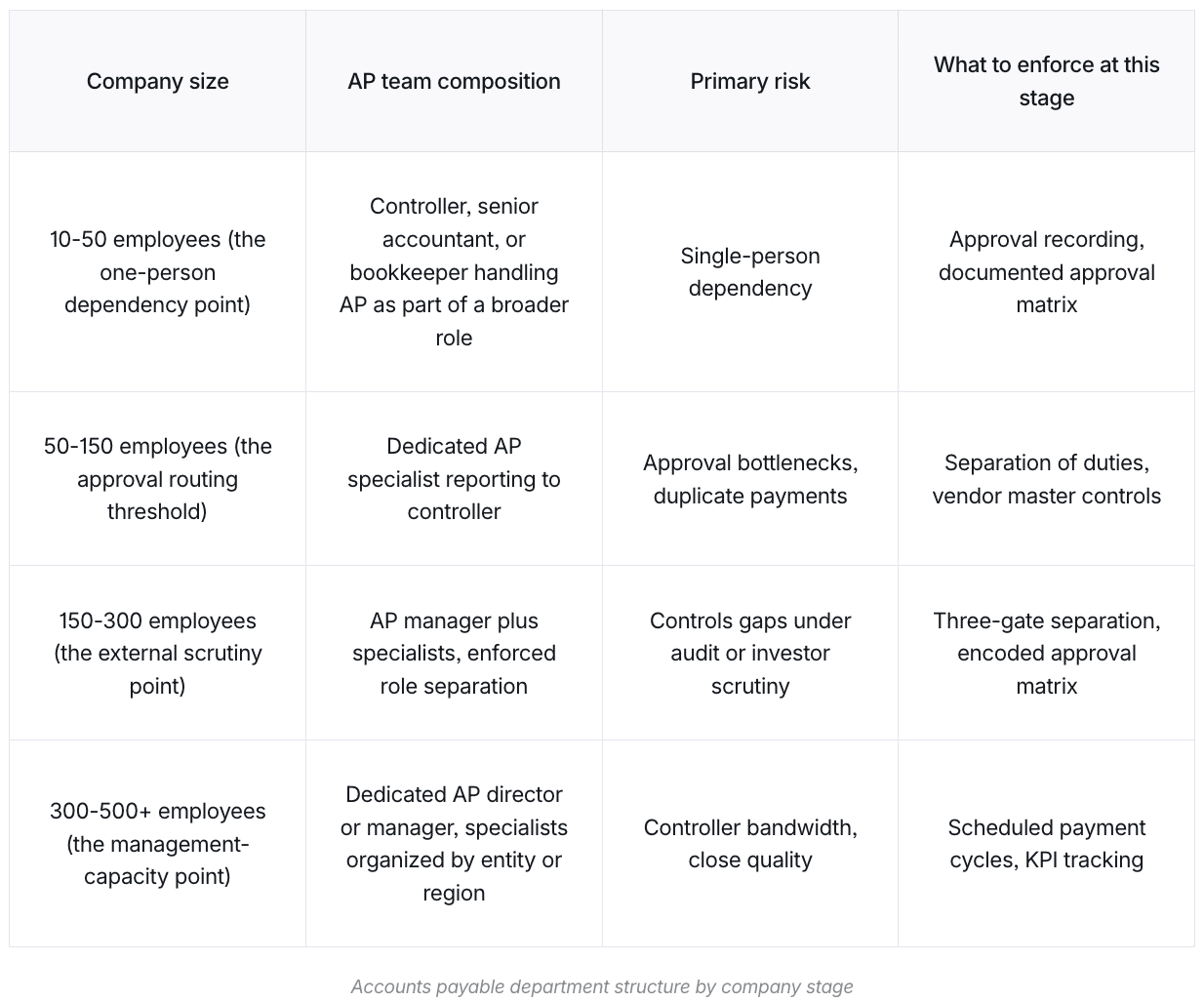
The one-person dependency point (10 to 50 employees)
At this stage, companies typically don’t have a dedicated AP function yet. It’s one responsibility inside a broader role held by the controller, senior accountant, or bookkeeper. When that person is out sick, on vacation, or heads-down on close, payments stop moving. Vendors don’t get paid on time, late fees accumulate, and by the time anyone notices, you’re already behind on close.
The approval routing threshold (50 to 150 employees)
At this stage, more people need to sign off on invoices. But the workflow for getting that done still relies on email threads and Slack messages that are untracked, undocumented, and invisible to the controller at close.
You’ll know you’ve arrived at this point when invoices are waiting on approvers instead of AP. If you don’t address the workflow bottleneck, close will fall behind because your approvers aren’t responding in time. To fix this, focus on creating a better approval workflow instead of adding more people.
The external-scrutiny point (150 to 300 employees)
By this point, your AP controls are no longer just an internal concern. As the company approaches a financing event or its first external audit, reviewers will start asking whether a single person can enter a new vendor, approve an invoice, and release a payment.
When that question comes up, it signals that your informal controls may not survive outside scrutiny. You’ll want to have separation of duties in place before someone outside your organization asks you why it isn’t.
The management-capacity point (300 to 500+ employees)
At this scale, the controller still typically serves as the de facto AP manager, overseeing daily operations, handling exceptions, and tracking KPIs (key performance indicators) on top of close, reporting, and compliance. That’s far too many responsibilities for one person to own.
You’ll know you’re here when the controller is consistently the bottleneck across multiple functions at once. When that happens, close quality slips, financial reporting falls behind, and exceptions pile up because the one person responsible for it all doesn’t have the bandwidth to keep up.
If any of these signals sound familiar, many finance teams look to automated bill pay to help them close the gap. Here’s how to structure your AP function at each stage to stay ahead of them.
How to structure an accounts payable department by company stage
The structure that works at 50 employees often fails at 150, while the one that works at 150 likely fails at 400. When yours starts to show signs of failure, identify what’s breaking in your AP setup before adding new people or tools. Use the following four principles to help guide how you build at every stage.
- Separate duties before an audit forces the change.
- Automate the manual layer before adding headcount.
- First fix what’s breaking in your current stage, then build for the next one.
- Size your team for invoice volume and exception rate rather than headcount.
How each of these principles plays out in practice depends on your team’s current size and structure. Use the table below as a quick reference, then work through the stage that matches your current size for the full breakdown.
Brex
Start with the process before a hire (up to 50 employees)
At this stage, the controller, senior accountant, or bookkeeper typically owns AP alongside a broader set of responsibilities. Before you make a dedicated AP hire, put three basics in place:
- Centralize invoice intake.
- Document a simple approval matrix.
- Adopt a platform that records approvals.
These three guardrails reduce single-person dependency in the payment process, which is a common risk at this stage. Building this foundation before you hire keeps the function from breaking at the next stage. When you’ve done that, make your first dedicated hire when exception volume outpaces what a part-time function can absorb.
Hire a dedicated AP specialist, then standardize (50 to 150 employees)
When the company gets to this size, AP needs a dedicated owner. You’ll want to hire an AP specialist reporting to the controller and give them ownership of intake, matching, coding, vendor communication, and payment runs. Keep exception handling, vendor master oversight, bank-detail change approvals, and audit liaison with the controller.
From day one, separate the person who enters a new vendor from the person who releases the first payment to that vendor. Enforce that separation as a permission setting in the platform, not just a policy they’re expected to remember.
Build a team with enforced separation of duties (150 to 300 employees)
By this stage, one specialist may no longer cover the volume alone. You’ll need to add more AP specialists and bring in an AP manager to oversee them. Enforce clear boundaries between invoice entry, approval, and payment release across the team. Give the AP manager workflow oversight, KPI tracking, exception escalation, and vendor dispute resolution.
Pair the team build with AP automation so the platform enforces the controls you put in place, rather than relying on people to follow a process manually. For companies managing multiple entities or locations, use this stage to define which controls apply across all entities and which need separate configuration by region or legal structure.
Create a standalone AP function with its own leadership (300 to 500+ employees)
At this scale, the controller can’t effectively oversee AP alongside close, reporting, and compliance. Appoint a dedicated AP manager or AP director who reports to the controller or VP of finance, and organize specialists by entity, region, or vendor category. Before adding headcount, ask whether each role adds exception-handling capacity or process ownership, and whether a better-configured platform would eliminate the work that role absorbs. This is when accounts payable management shifts from transaction processing to coordinating people, systems, and entities.
Enterprise resource planning (ERP) also becomes a structural decision at this stage. With specialists organized across entities or regions, your AP tool needs to sync cleanly with your ERP so data doesn’t have to be reconciled manually at close. If it doesn’t, fix that before making any other structural changes.
5 AP controls that keep your function audit-ready at every stage
The five controls below separate AP teams that scale cleanly from teams that need to rebuild their function every 18 months. They’re also what you’ll need to have answers for when an auditor, board member, or acquirer asks how your AP department runs.
Each one connects directly to accounts payable best practices that high-performing teams put in place before they’re forced to. Note that accounting controls, role design, and approval policies depend on your company’s specific facts, audit requirements, and the guidance of qualified accounting or audit professionals.
Enforce three-gate separation before the first external audit
Set up three distinct roles:
- One person who enters invoices
- A second who approves them
- A third who releases payment
On a two-person team, use a compensating control where the controller owns at least one gate, usually payment release, so no single person controls the full cycle. Other common ways small teams can implement compensating controls include requiring a second sign-off on payments above a certain threshold, or having the controller review and approve the vendor master before any new vendor receives a first payment.
Ideally, though, you want to enforce these separations with platform permissions rather than a policy people are expected to remember. Building this control during a calm period is far less disruptive than retrofitting it under audit pressure.
Put a second reviewer on vendor bank-detail changes
Changes to vendor bank details need a second review because they affect the payment destination itself. According to AFP’s 2025 Payments Fraud and Control Survey, business email compromise was cited by 63% of organizations as the top avenue for payments fraud in 2024. Verification should include a callback to a phone number from existing company records, not from contact information included in the change request itself. Build this into your workflow so an approver doesn’t skip this step when they’re moving fast.
Encode the approval matrix in the platform
An approval policy that lives in someone’s memory usually disappears when that person leaves. Define approval thresholds by invoice amount, department, vendor type, and spend category, then configure them directly in the AP platform so routing happens automatically.
Run scheduled payment cycles
Ad hoc payment requests interrupt batch processing, create out-of-sequence audit trails, and often bypass approval steps. Move to a fixed weekly or biweekly payment schedule to smooth AP workload and give the controller a more predictable cash outflow rhythm. For exceptions, require explicit escalation with a documented reason. This directly addresses the approval routing problem from the 50 to 150-employee stage, since it gives AP a structured payment processing window and approvers a predictable deadline.
Track three AP KPIs each close
The three KPIs below can give you the clearest picture of how well your AP function performs each close:
- Cost per invoice reveals whether manual processing inflates your unit costs.
- Invoice cycle time reveals where approvals or exceptions create delays.
- Invoice exception rate reveals how much manual work drags down the other two figures.
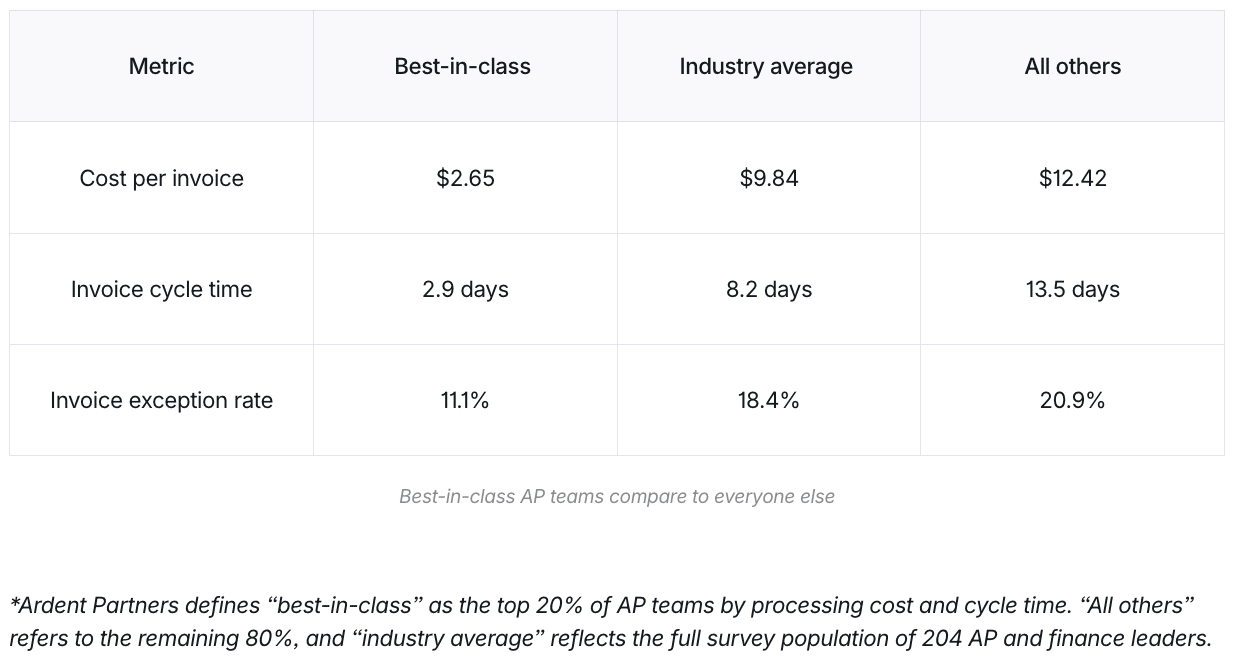
Here’s how best-in-class AP teams compare to everyone else, according to a 2025 report from Ardent Partners:
Brex
Without these three numbers, the hire-versus-automate decision is often less reliable. Cross-reference your own numbers against accounts payable metrics benchmarks to understand where you fall.
When to hire and when to automate your AP function
The decision to hire another AP specialist or invest in better tooling typically comes down to one question: Where does the bottleneck come from? If the problem is a broken process, another hire won’t fix it. Use the signals below, together with guidance from your appropriate professional advisor, to help inform your decision.
Automate if:
- Your AP specialist spends more time chasing approvals than processing invoices.
- Your cost-per-invoice hasn’t decreased as invoice volume has grown.
- Cycle time is driven by approval bottlenecks rather than pure volume.
- Your exception rate is above 18.4%, the industry average reported by Ardent Partners.
Hire if:
- Invoice volume has outpaced what one specialist can process even with automation in place.
- Exception volume consistently requires human judgment that tooling can’t handle.
- Your AP manager spends time on transactional work instead of oversight.
If you get mixed answers, automate first. A better-configured platform usually reveals whether you actually need a hire.
FAQs about accounts payable departments
What does an accounts payable department do?
Accounts payable (AP) manages your company’s outstanding vendor invoices, from receipt through payment clearances. Core functions include:
- Invoice capture and validation
- GL coding
- Two-way matching against purchase orders and receipts
- Approval routing
- Payment execution
- Vendor master management
- AP reporting for close, cash flow forecasting, and audit support
What are the roles in an accounts payable department?
Typical accounts payable roles break into three tiers. The AP clerk or specialist handles invoice processing, coding, and vendor communication. The AP manager or director is responsible for workflow oversight, KPI tracking, and exception escalation. The controller often retains approval authority, vendor master oversight, and audit liaison as the function gets more complex.
How many people should be in an accounts payable department?
There’s no fixed number. Team size depends on invoice volume, exception rate, and approval complexity. A single AP specialist can often cover low-volume, low-exception workloads, with additional clerks, a manager, and clearer separation of duties added as volume and control needs grow.
When should a company hire a dedicated AP manager?
Companies often need a dedicated AP manager when the controller can no longer provide operational AP oversight alongside close and reporting responsibilities. The trigger is often an upcoming financing event, acquisition conversation, or first external audit that raises the bar for workflow oversight and control documentation.
When should a company automate AP instead of hiring more staff?
Automate first if the bottleneck is process friction rather than volume. Signs of process friction include an AP specialist spending more time chasing approvals than processing invoices, or an exception rate above the industry average.
What is the difference between accounts payable and accounts receivable?
Accounts payable manages what the business owes to vendors, representing an outbound payment obligation. Accounts receivable manage what customers owe the business, representing an inbound collection asset. Both are current accounts on the balance sheet. AP is a current liability, and AR is a current asset.
Disclaimer: This article reflects Brex’s perspective at the time of publication and is intended for general informational purposes only. It is not intended as legal, tax, accounting, or financial advice. Laws, regulations, and guidance may vary based on your specific circumstances, and interpretations or outcomes may differ. Information may also change over time. Before making any decisions, you should consult your own qualified legal, tax, accounting, or financial advisors.
This story was produced by Brex and reviewed and distributed by Stacker.

